
The transformation of the labor market does not always mean the disappearance of professions. More often, the nature of work changes: tasks that once took hours can be completed faster with the help of AI. At the same time, professionals are required not only to learn new tools but also to formulate tasks correctly, evaluate results and make informed decisions.
According to LinkedIn, about 1.3 million jobs related to AI and more than 600,000 related to data centers were created worldwide between 2023 and 2025. These figures refer specifically to jobs created, rather than open vacancies. The data show that the development of AI is accompanied not only by changes in existing professions but also by the emergence of new jobs.
In its Future of Jobs 2025 report, the World Economic Forum forecasts that 170 million jobs will be created and 92 million displaced by 2030. Net employment growth will amount to 78 million, although this figure reflects the combined impact of economic, technological and demographic changes. The WEF directly links AI and information processing to the creation of 11 million jobs and the displacement of 9 million.
The impact of AI is primarily reflected in changes to individual tasks. According to the International Labour Organization, about one-quarter of workers worldwide are employed in occupations that could potentially be affected by generative AI. At the same time, changes to existing duties are considered more likely than full automation. The greatest potential impact is seen in areas such as programming, data analysis, design and text-related work, particularly in digital environments.
A study by German-American economist Alexander Bick shows that employees who have used generative AI for at least six months apply it to a broader range of operations. However, this effect is difficult to measure precisely. For example, 15% of requests to AI are related to editing, while the O*NET database lists this task for only 2.4% of workers. The difference between these figures may be related to the characteristics of the data used and the methodology for calculating them.
In service roles, less experienced employees recorded the greatest productivity gains from AI, while the gains among experts were more modest. This points to a more noticeable effect of AI use among workers with less experience.
The WEF lists not only AI developers and data analysts among the fastest-growing professions, but also specialists in education, care and construction.
The transition to working with AI does not mean that everyone needs to change professions. A more practical approach is to combine professional expertise with new tools: understand one’s field, check the results produced by neural networks and take responsibility for the final outcome. A more sustainable strategy is to remain ready to learn continuously, acquire new skills and maintain independence in decision-making.
These skills begin to develop in childhood. The habit of learning and creating helps develop thinking, character and an attitude toward life. A love of reading, an interest in knowledge, and the ability to reflect and analyze are formed through education, communication and the surrounding environment.
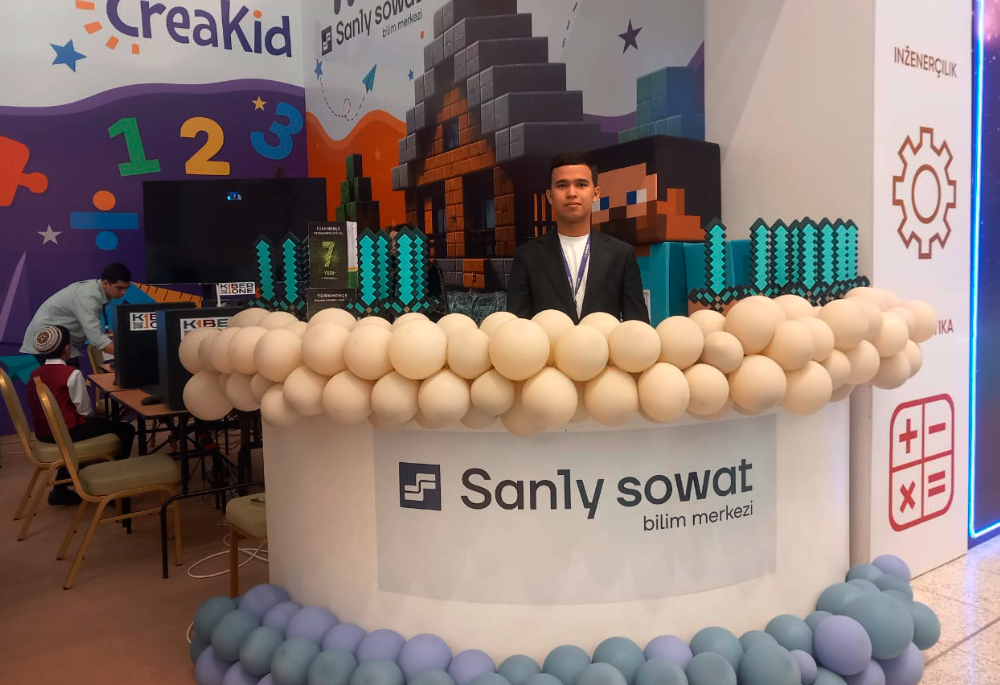
At the Sanly Sowat educational center, children learn not simply to receive information, but to think more broadly, discover their abilities and interact confidently with the world. Here, children are helped to develop curiosity, creativity, communication skills and a desire for self-development — qualities that help shape an independent, well-rounded and self-confident person.
Sanly Sowat Educational Center
Contact:
+993 63 639192
+993 62 525638
Addresses:
57A Görogly Street, Ashgabat
Älem Building, Garashsyzlyk Avenue, Ashgabat