
We are living through a period of historic technological change. Artificial intelligence (AI) has already become an integral part of daily life, and experts say its influence will continue to grow. AI is no longer just a tool — it is an emerging environment shaping education, business and society.
Researchers view AI as a key technology with applications across virtually every sector. It has the potential to improve quality of life and help address global challenges, including climate change and public health crises.
One critical factor is often underestimated: AI is only as effective as the questions it is given. Users often express disappointment, saying AI produces weak or irrelevant answers. In most cases, the issue lies not in the system, but in how the request is formulated.
The outcome depends not only on AI capabilities but also on how people interact with it. This is where a key skill comes into play — the ability to craft effective prompts.
A prompt is more than a request. It reflects a way of thinking: clearly defining a task, structuring ideas and understanding the desired result.
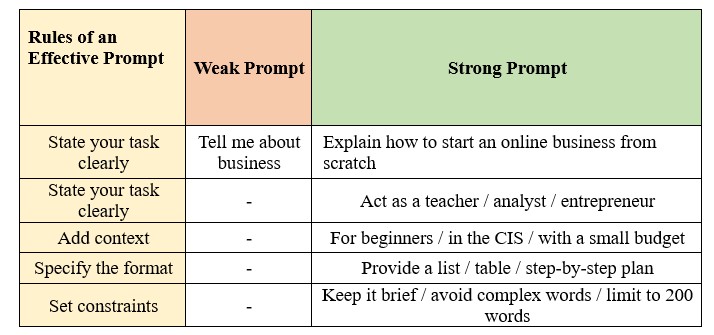
A strong prompt is clear, specific and well-structured. It helps AI interpret the task accurately and deliver useful, precise responses. A weak prompt, by contrast, leads to vague or incomplete answers.
As access to AI expands, those who know how to use it effectively will gain the greatest advantage. Strong prompting saves time, improves output quality and opens new opportunities. Students can grasp complex topics faster, educators can create better materials and businesses can make more informed decisions.
People who write effective prompts can learn faster, analyze more deeply, develop stronger solutions and make better decisions under uncertainty.
This shift marks the emergence of a new form of literacy — prompt literacy. Just as reading and writing once became essential skills, the ability to communicate effectively with AI is becoming a foundation of competitiveness.
In the coming years, this will divide users into two groups: those who use AI superficially and those who leverage it to enhance their capabilities.
The key question is no longer whether AI will replace humans, but whether people can work effectively with it. The answer begins with a simple skill — asking the right question.
In essence, prompt writing is becoming as important as reading, writing and analytical thinking. Those who can communicate effectively with AI gain a significant advantage in education, work and personal development.
Artificial intelligence today can perform a wide range of tasks — writing texts, explaining complex topics, supporting business decisions and even programming. Its effectiveness, however, depends entirely on how precisely tasks are described.
A prompt is an instruction given to AI. It can take the form of a question, request, instruction or task.
AI does not think like a human. It interprets text, identifies patterns and generates responses based on context by predicting the most relevant answer.
The more precise the instruction, the better the result.
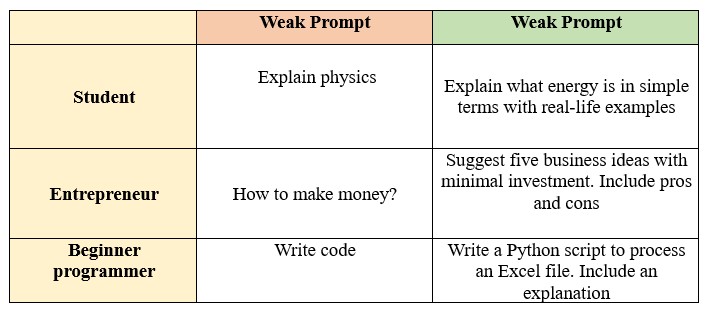
For example, a vague request such as “Do something” produces random output. A specific request such as “Analyze the U.S. online education market with examples and conclusions” can yield a near-complete analytical report.
In the past, making computers work required coding. Today, programming relies on strict commands, while AI relies on clear language. In simple terms: programming is precise instruction, while prompting is clear explanation.
Real-Life Examples
How to Build a Strong Prompt (Step by Step)
Step 1: Define the role — expert, teacher or analyst
Step 2: Specify the task — explain, create or analyze
Step 3: Identify the audience — beginners, professionals or businesses
Step 4: Choose the format — list, article or step-by-step guide
Common Mistakes
Users often make the following mistakes:
- Asking overly broad questions
- Lack of specificity
- Including too many requirements
- Expecting a perfect answer on the first attempt
In practice, working with AI is a dialogue. The best results come through iteration: ask, receive, refine and improve.
If formulating a request is difficult, a simple solution is to ask AI to generate an ideal prompt for your task.
Today, prompt writing represents a new skill, a new literacy and a faster way of working. Those who ask better questions get better answers.
Universal Prompt Template
Act as an expert in [X].
Explain in detail [Y].
Include:
- theory
- practical examples
- step-by-step guidance
- common mistakes
Make the response structured and easy to understand.